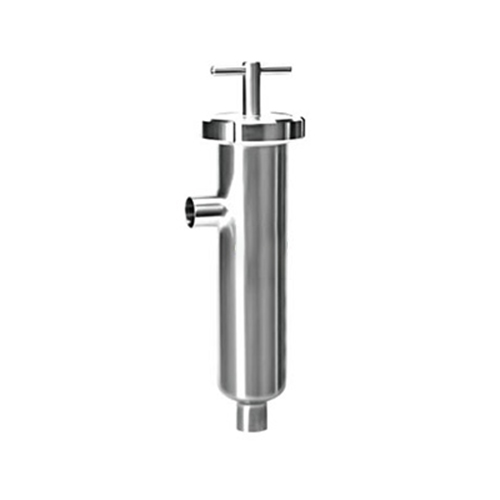
Sanitary angle type strainers are highly engineered, hygienic components designed to remove particulate solids from fluid processing lines. By capturing debris equal to or larger than the internal mesh size, these strainers provide critical inline protection for downstream equipment such as pumps, homogenizers, heat exchangers, and sensitive instrumentation.
Featuring a specialized 90-degree angle design, they serve as efficient, space-saving fluid-handling solutions that can be easily integrated directly into piping corners.
The strainer assembly consists of a high-purity inlet/outlet body and a heavy-duty internal filter element.
Crevice-Free Geometry: Designed to meet strict sanitary standards, preventing product stagnation and bacterial growth.
Easy Maintenance: The angle-type design allows for quick dismantling and effortless removal of the inner filter mesh for cleaning, flushing, or replacement without disturbing the piping footprint.
Technical Specifications
Parameter
Specification Range
Available Sizes
DN25 to DN150 (1″ to 6″)
Operating Temperature
-10°C to +120°C (Standard EPDM configuration)
Maximum Working Pressure
10 bar (145 PSI)
Perforation Hole Diameters
0.5 mm to 2.0 mm
Filter Mesh Range
30 Mesh to 300 Mesh
Hygienic Standards
3A, DIN, SMS, RJT, IDF
Materials & Configurations
To ensure chemical compatibility with diverse media and aggressive Clean-in-Place (CIP) regimes, we offer flexible material configurations:
Body Materials: Available in high-purity Austenitic Stainless Steel (SS304 or SS316L Pharma Grade).
Gasket Options: High-performance elastomers tailored to your processing temperature and chemical resistance needs:
Silicone (MVQ)
EPDM
Viton (FPM)
End Connections: Engineered for seamless system integration:
Tri-Clamp (Hygienic Quick-Disconnect)
Threaded / Union Connections
Butt-Weld (For permanent orbital-welded lines)
FAQs
Q1: What is a sanitary angle type strainer used for?
A: A sanitary angle type strainer is installed inline within hygienic processing systems to remove unwanted particulate solids from liquids. Its primary purpose is to safeguard expensive downstream equipment—such as sanitary pumps, valves, meters, and heat exchangers—from mechanical damage caused by debris, while ensuring product purity.
Q2. What is the difference between an angle strainer and a Y-strainer?
A: The primary difference lies in geometry and installation footprint. An angle strainer forms a perfect 90-degree bend, allowing it to replace a piping elbow and save space in tight configurations. A Y-strainer is installed on straight pipelines where the filtration leg branches off at an angle. Angle strainers typically offer lower pressure drops and easier element removal in corner layouts.
Q3. Why are angle type strainers critical for sanitary food and beverage processing?
A: They provide essential inline protection for expensive downstream equipment like sanitary pumps, homogenizers, and heat exchangers by capturing rogue particles (e.g., fruit seeds, gaskets debris, ice crystals). Their crevice-free, high-polish finish prevents bacterial stagnation, making them fully compliant with food safety regulations.
Q4. How do I choose the right mesh size for my sanitary strainer?
A: Mesh selection depends on the particle size you need to eliminate and the viscosity of your fluid. Coarser filtration (30 to 80 mesh; 0.5mm to 2.0mm holes) is ideal for larger debris protection in high-viscosity liquids like creams or syrups. Finer filtration (100 to 300 mesh) is used for polishing low-viscosity fluids like water, beer, or thin juices.
WE ARE HERE TO SUPPORT YOU!
Further information or a personal consultation? Our products and know-how
are there to provide solutions.