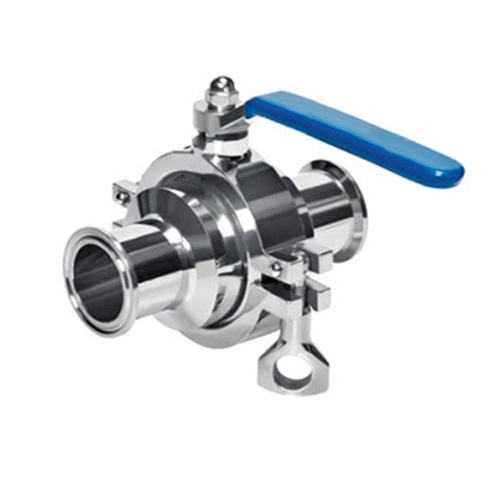
The manual sanitary non retention ball valve features a premium full-inclusive, encapsulated ball seat design. This engineered structure completely eliminates the traditional cavity gap between the valve body and the ball, solving the critical industry problem of fluid holdup, product stagnation, and cross-contamination.
Engineered strictly for high-purity processing, this valve is highly recommended for sterile liquid transfer lines across bio-pharmaceutical engineering, specialized cosmetic formulations, and high-purity food systems.
High-Temperature & Low-Torque Performance
Patented Stem Seal: Utilizing a spring-compensated live-loaded design, this valve guarantees an ultra-long service life with exceptionally low operating torque.
Thermal Resilience: Ensures reliable, long-term, zero-leakage operation under continuous high-temperature sterilization cycles up to 150°C (with optional upgrades up to 200°C).
Tool-Free Maintenance: Designed for rapid field servicing; the valve body can be fully disassembled for inspection or gasket replacement without requiring specialized professional tools.
PTFE / TFM (Fully compliant with FDA 177.1550 & 177.2600)
Temperature Ratings
Standard: -20°C to 150°C | Optional High-Temp: -30°C to 200°C
Pressure Ratings
10 bar to 30 bar (Depending on size, temperature, and seat material)
Actuation Flexibility
Interchangeable manual handle, pneumatic actuator, or electric actuator
End Connections
Tri-Clamp, Butt-Weld, Threaded / Hygienic Unions
Design Standards
Fully compatible with ASME BPE, DIN, SMS, ISO, IDF, RJT
FAQs
Q1: What is a non-retention ball valve and why is it used in bio-pharma?
A: A non-retention ball valve (also known as an encapsulated seat ball valve) utilizes a cavity-filled PTFE seat that wraps tightly around the ball element. In standard ball valves, fluid gets trapped inside the body cavity when the valve opens or closes, leading to bacterial growth. The non-retention design fills this empty space completely, eliminating fluid holdup and making it essential for sterile bio-pharmaceutical processes.
Q2: Can this non-retention ball valve handle continuous Steam-in-Place (SIP) at 150°C?
A: Absolutely. Thanks to our patented stem seal design with a spring-compensation mechanism, the valve automatically adjusts for thermal expansion and contraction. The standard setup handles continuous operational temperatures up to 150°C, making it completely resilient against aggressive SIP steam sterilization.
Q3: Why is a spring-compensated stem seal design critical for industrial ball valves?
A: Traditional valve stem packing wears out over time due to friction and thermal cycling, causing dangerous micro-leaks. A spring-compensated (live-loaded) design maintains constant, uniform pressure on the stem seal automatically. This significantly extends the valve’s operational life, prevents pressure loss, and maintains a small operating torque over years of service.
Q4: How does temperature affect the working pressure of a PTFE-seated ball valve?
A: Like all thermoplastic-seated valves, the maximum allowable working pressure drops as the process temperature increases. While the valve can handle up to 30 bar under ambient conditions, at peak temperatures near 150°C, the pressure rating adjusts downward to ensure the absolute structural integrity of the PTFE/TFM encapsulation.
WE ARE HERE TO SUPPORT YOU!
Further information or a personal consultation? Our products and know-how
are there to provide solutions.